
Carrier Concentration and Energy Level Concepts in Semiconductors
In semiconductors, the carrier concentration and the position of energy levels depend strongly on temperature, doping concentration, and intrinsic material properties.
Understanding these variations is crucial for analyzing and designing semiconductor devices.
Temperature Dependence of Carrier Concentration
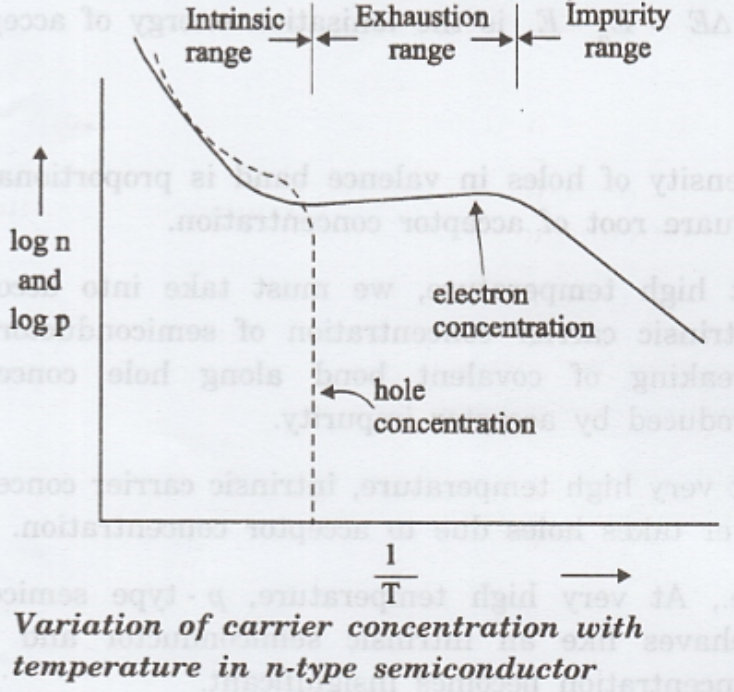
In a semiconductor, the free carrier concentration changes significantly with temperature due to the ionization of dopants and the generation of intrinsic carriers.
The variation can be divided into three distinct regions:
- Freeze-out Region → At low temperatures, donor or acceptor atoms are not fully ionized. Carrier concentration is much smaller than the doping level.
- Extrinsic Region → At moderate temperatures, dopants are fully ionized and carrier concentration remains nearly constant, determined by the doping concentration.
- Intrinsic Region → At high temperatures, thermally generated intrinsic carriers dominate over dopant-generated carriers.
The normalized carrier concentration ( n / N_D ) is approximately:
where the intrinsic carrier concentration ( n_i ) is given by:
Where:
- (N_C) → Effective density of states in the conduction band
- (N_V) → Effective density of states in the valence band
- (E_g) → Bandgap energy
- (k) → Boltzmann constant
- (T) → Absolute temperature
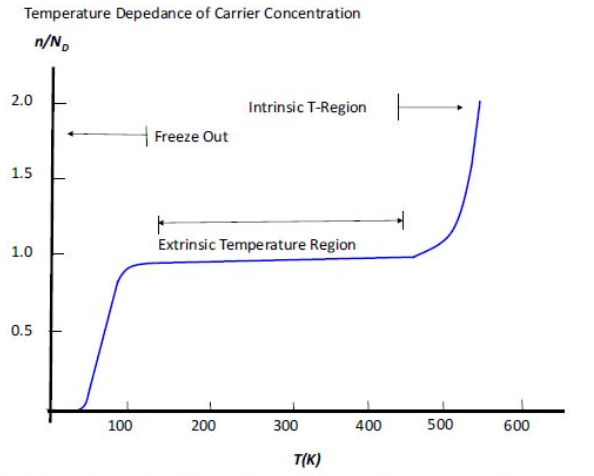
Energy band diagrams at different temperature ranges illustrate electron excitation from donor levels to the conduction band.
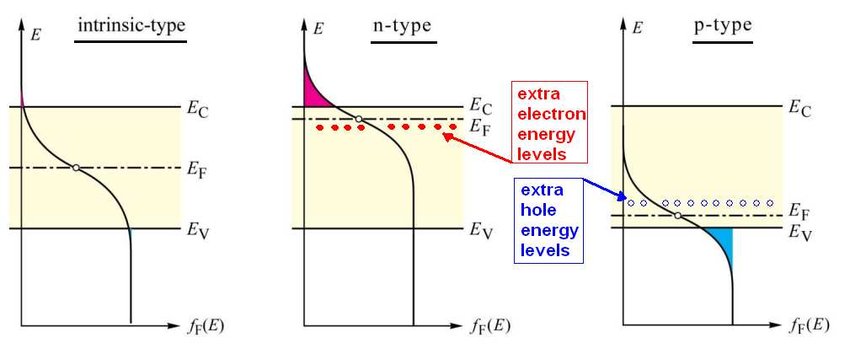
Position of Fermi Energy Levels with Respect to Doping
The Fermi level (E_F) in a semiconductor indicates the probability of occupancy of electron states.
Its position depends on the doping type and concentration.
For n-type Semiconductors
In an n-type semiconductor, the Fermi level lies closer to the conduction band due to the higher concentration of electrons:
Where:
- (E_C) → Conduction band edge energy
- (N_D) → Donor concentration (assumed fully ionized)
For p-type Semiconductors
For p-type materials, the Fermi level lies closer to the valence band:
Where:
- (E_V) → Valence band edge energy
- (N_A) → Acceptor concentration
Note: In highly doped semiconductors, the Fermi level may even lie inside the conduction or valence band, entering the degenerate regime.
Equilibrium Concentration Relationships
In thermal equilibrium, the electron and hole concentrations in a semiconductor obey the mass action law:
Where:
- (n_0) → Equilibrium electron concentration
- (p_0) → Equilibrium hole concentration
- (n_i) → Intrinsic carrier concentration
Charge Neutrality Condition
For n-type semiconductors:
For p-type semiconductors:
Where (N_A^-) and (N_D^+) are the ionized acceptor and donor concentrations, respectively.
Carrier Concentrations in Doped Semiconductors
For non-degenerate, fully ionized doping:
n-type semiconductor:
p-type semiconductor:
These relationships are fundamental in analyzing semiconductor behavior under equilibrium and form the basis for understanding carrier transport under non-equilibrium conditions.